Monday, February 20, 2012


2-20-2012- them sludge eating buzzards

    there was 20 buzzards in the tree when i took this pic. and yes they were close to the farm but not actually on it . but i have seen this same flock of buzzards in this area around our farm and the city farm but really doesn't mean much unless you happen to be dead.  they seem to like our area as there is a lot of road kill in our area. also it is not unusual to  see garbage bags of dead deer parts and skin dropped off on the road at end of the lane , or even up our lane. we used to be the prime area for dumping trash , but i have managed to keep the weeds down along the lane and do pursue any person with no real reason to be up the lane. i have chased tire dumpers and others who i knew were violating the land. and to top it off . the worst thing i saw was a bag of dead dogs someone decided to share with me. thanks who ever you were as it was the middle of the wintertime and digging was tough but i still managed to dig me a hole and said a few words over the dogs for you. it never ceases to amaze me how people can take an area of innocence and turn it into a dumping ground. or maybe they were just feeding the buzzards. 
      having an isolated drive is a hard thing to have sometimes, as i cant always see what people are up to. you would hope for the best but expect the worst. we have had cars abandoned on our property and the occasional lovers looking for a place to get away ,  we have occasional walkers , mostly neighborhood people and i welcome them. it is always nice to see them , and i know as long as they are around things will be safe as they will help watch things. 
       
       well back to lake cmich or the lake along side our lane that used to be there. . it was designed and sold to us residents of pike township as a temporary storage facility. it would only be in place till the new sewage treatment expansion was in place. and running , but no longer than 5 years. well it was more like 15 years it was in place and had undergone a metamorphosis of sorts. 
       before they even finished excavating the bottom of the lake, and the sides were barely up , they started in dumping sewage into the lake. a cold spell came up on us and soon they were dumping car sized frozen chunks of fill in the dike that surrounded at least 3/4 of the lake. and the sewage just kept pumping daily soon the bottom was covered and before they finished the top of the dam , the frozen soil melted and caused structural damage to the levee. they had to remove part of the levee and re install it just above the sludge line. before the grass was seeded around the outside of the pond, the pond was nearing being filled .a temporary restriction to stop filling was soon lifted. 
        at first the city workers who once tended the ditches and worked in fields spreading the sludge till it caught fire , now had a new job of tending to the pontoon boat cruising around the lake spraying insecticide , and generally just stirring things up. no doubt in my mind this was a job benefit compared to the shovel they were using before. alone in a sea of sludge just you and 50 trillion flies , how romantic . i digress. 
        this went on for a couple of years and swarms of tiny black gnats would be so thick you would have to keep your mouth closed , or face the prospect of eating them as  we walked alongside that lake on the lane to our farm daily on our way  to catch the bus down on east sparta ave.. after a couple of years you could now see the lake begin to separate into water and sludge islands. birds were resting on these sludge islands,  and flocks of geese would spend nights there . soon deer and other animals including the occasional idiot fisherman would stop by to try and land them a big one. don't really know as there was fish there , but never really considered eating anything associated with the pond. and again i thought , there is no better way to screw up a perfectly good piece of property than what they had there. what a load of crap this was.  
       and soon i believe the city workers  retired as the pond had no visible signs of maintenance for years. then finally after about fifteen years they finally returned to remove the pond. by now it was quite a thriving ecological community, a migratory stop for geese, thousands would stop on their way, and the pond was officially showing up on maps . and is still located there today , yet the lake has been removed. in a way i was kind of sad to see them remove the pond, as now it had become home to a wide range of animals. its rugged straight lines , kinda smoothed out mother nature. and the animals had become accustomed to it. but i was still glad none the less.  
      soon they were draining the lake and removing the sludge and i believe they hauled that to mt . trashmore for disposal. so now you have a bunch of sludge mixed with garbage stewing in the landfill. well they cleaned it all up and seeded it down . this would all be good except for one thing. for over fifteen years they had a pool of sludge sitting on a water aquifer that was sand and gravel . totally unsuitable for a storage facility handling sludge. the weight of the sludge was like a huge hydraulic ram pumping sludge residue into the same water aquifer that a lot of neighboring wells use. ours is above this level but buy bottled water for myself and mom uses special filter to screen her well water to just be safe. with the marcellus shale drilling and strip mine usage we feel it is important to document our wells performance so will be doing well testing soon. the field is wide open at this point , with spotted vegetation but mainly grasses as again it has a chance to heal itself.
      also over the years there has been considerable mining done on this property and there is hardly an acre that has not been turned up side down and around , as they went in 2 different times to an area previously strip mined and recovered coal. then they were allowed to plant only trees with out nuts to avoid transfer of heavy metals to other forms of life. the continued use of the farm over the years as a sludge dumping facility and landfill as this is the place they also dumped everything that came off the screens at the sewer plant. rubbers, seeds,tampons etc were dumped in this one area on the farm. it was like a smorgas board for vegetables . you had sludge watermelons three feet long green and ripe ,pumpkins, cucumbers , muskmelon, if it grew by seed and could pass someones intestines then it was growing there somewhere.  this mining had turned most of the sewage under or spread it around so much it may never be a risk at all. there are areas in the valleys and in the bottom of the ponds where i am sure you will still find sludge residue. 
       the land is quiet again. talks of a park were scattered around and opinion wasn't running high in favor of that . they also found a new piece of land that they didn't screw up and was getting ready to move forward on that also. with the marcellus shale and the farm as big as it is , i imagine soon they will be placing a rig on their land. the city of canton should score big on leasing money. i am sure of one thing , there is no limits as to how far the city  of canton would go to if they thought they could profit off the farm. they dont live here. 

Sunday, February 19, 2012


2-19-2012- hate that when that happens. 
city of canton part 2

       a friend of mine now and who was considerably older than i was when i was about 8 years old had taken me and my brother coon hunting on the city farm. this was before they had lagoons instead they had large sludge ponds and that was the term they used for it as , no one used that four letter word s---much back then, when i was that age.
     carl poole was the friends name and he was doing me a favor as we were out coon hunting of which i really did none but instead chose to go along and enjoy this adventure. it was always nice to get to see areas close to home as little coves , strip mines and brier tangles allowed for plenty of cover. we never knew what was going to turn up . i was never crazy about hunting. i liked to go along and at first feigned an interest in hunting to just be involved in the excitement that occurred on a hunt. well i was getting tired as it had been awhile since we last saw the dogs, and the thing about coon hunting is that it seems like the dogs are always just over the hill. i was tired and carl offered me a ride on his shoulders, and i gladly accepted being much smaller than i am now but still a good size chunk. carl is still a good  man of swarthy stature and much like my self now minus my gut. i was still a load for him as we climbed to the highest hill on the city farm. this is where the sludge starts. several times we had crossed ditches as we followed the dogs.
      we had been climbing a while up hill through the trees and into an opening while all the time walking in the dark of the night with just one flashlight leading the way. me on carls'  back and fighting the still heat of the night as i felt carl start to wobble forward and i grabbed his head and leaned back as far as i could as he just about walked into a sludge pond. he reeled back with me on his shoulders like a weeble and he never fell down , but it was close. i was down in a flash, off his shoulders  and we all just sat there and laughed at how close we were to going headfirst into the sludge pond black goo, Texas tea. still sends shivers up my spine.
       this was where it all begins from a famous slogan as everyone knows s--- runs down hill. well some enterprising person decided to get a sewer line to the top of this  hill and would run sludge into the pond , and from there it went on its paths down a circuitous  route  over the hills for miles as it snaked around the hillsides. black goo could be seen in wide swaths basking in the sun drawing flies to feed. the smell would change your appreciation for anything else besides this stuff. 
       we americans' eat healthy and at times to well, and in canton they would pipe this affluence south in a huge sewer line i believe still exists today along side the nimisilla creek to the old sewage treatment plant across st rt. 800,from the end of east sparta ave. close to our home. from the old plant the line went towards and under st. rt . 800 and into the field beyond the intersection of st. rt . 800 and east sparta ave. imagine it is still under there , just has portions abandoned. then it would run across the field and straight to top of the hill. where they would dump it into the pond we almost fell into. animals would sometimes wander into these ponds and die as when they fell in, the sludge would act like quicksand to envelope and encase anything that touched it. and really to fall in this pit would be worse than you can imagine we felt like we had escaped death that day. and it was years again before i attempted coon hunting . having a vivid memory of that night. 
       well s--- happens as it did one day in the summer not long after that as firefighters were called to put out a blaze on a field saturated by sludge , that had started when a city worker had threw his cigarette down and started a grass fire fire that would burn and smolder for over six months. they had to bring in dozers and corral the blaze in as they cut a fire ring around the exterior of the burning area. this allowed the center to eventually burn over 20 acres of land up, trees and all. the flames had mostly burned out in a couple of days of hot weather but the sludge they had poured over the years and had accumulated in depths of up to 4-5 foot in places was now burning like peat or firewood, only not in open flames but in a slow burn below the surface . pocking the surface of the burned out area to resemble what one would imagine the moon to look like. a vast barren crater filled gray dusty , and downright un forgiving place. isn't it amazing how us humans can take an otherwise perfect image of eden and transform it in to our personal hell with out trying? 
        after awhile we had the chance to go visit his place and we did try to walk through the field and we would sink into some places up to three feet or more and it made walking hard to do. in the summer this area was covered by grass, and then the sludge was spread over the land covering the grass. the grass would die somewhat but always managed to survive and grow again . we walked over this grass and it would hurt your legs after awhile as it was so soft to walk on. year after year of accumulation resulted in this fire.  they had spread the sludge for over thirty years this way and so after this episode they needed to do something else . their next effort was the six pond sludge facility and then the lake. 
      well i am trying to get you back to the lake we commonly referred to as lake cmich, who was then canton mayor and so needed honored. at that time it seemed as if what ever canton wanted to do it was fine with our local government . we didn't seem to have much say in anything that went on. as kids i saw it as an exciting way to watch new construction. as an adult i have mixed emotions about the whole thing as you can tell or will be able to tell after i finish writing about it. well tomorrow we will be getting around to the building and eventual destruction of lake cmich. no sludge.or yes there was bunches of it. 
     the pictures i thought were pretty as friend of mine was in agreement so i decided to use them as they are closest thing to city farm that is still pretty and takes your mind off those other hellish images i tried to portray as realistically as i could. and these were from February 2, 2011. according to time stamp on digital picture. 

Saturday, February 18, 2012

2-18-2012-city of canton sewage farm 
part 1
      cant say exactly when it was when the city of canton oh. originally bought up the farms that make up the city of canton farm but knew that when finished , was made up of 640 acres. as you drive up the lane the land on the left and the right belongs to the city of canton. i have been maintaining the road as it is our access road . once you get to the point where it appears the road separates into a y , this is the beginning of our 40 acres. and we still live another quarter mile back or a total of about a half mile. may not be exactly a half mile , but believe me there were plenty of days it seemed longer especially when you had to walk it. and at night , it seemed a for sure that something would be along the road before you ended up home half scared. long enough as i said., 
     when we were younger we had neighbors , in fact a couple i could think of. most notable was kenny and nancy capes , and their kids , kenny , lori, and cindy. kenny was a year younger and cindy the tomboy was closer to my age , and lori who was my age and went to school same as i did and most notably their dad farmed dogs it seemed .  . before that was tex whitted , tom whitted's dad, they had horses. and at times we had our cattle over there also pasturing the land and using the barn. 
       the house and barn were huge and the place was laid out like a mansion. it had a huge house that was actually 2 separate houses, yet were still attached with a door to separate the 2 houses. one side was 10 rooms at least as it had a study upstairs and 4 bedrooms i believe. and down stairs a huge kitchen , and a huge dining room and living room with 10 foot ceilings and a large welcoming front door and an off the kitchen pantry. the other side was a modest 2 rooms down and 3 rooms up,and both sides were connected in the front of the house with a wide L shaped covered porch extending the whole length of the house.
         the barn was at least 40 by 100 and had horse stanchions and was set up to milk cows as the sylers did when mom was growing up back here on farm around 1946, or just after the war. the barn was a well built bank barn w/ wood siding . some of the boards used in building this barn were virgin timber. we still have a couple of the boards here on our farm that were salvaged when they tore the barn down. they are over 36 incches wide planed poplar. square cut corners and finished boards . go to a lumber mill and try and find that in a 16 foot length. it was all barn,ornate and white washed , with a grainery to store grains produced on the farm . it also had a milk house and spring that produced really ample amounts of water but had an unpleasant smell. i would wait till i was home before drinking water. there was also a couple of large equipment sheds around the farm serving a dual purpose as storage and corn crib. at one time there was a silo but that was tore down. 
       this was our closest neighbor and they were not even close as their house is still a good quarter mile away. the picture above is looking at where the house and barn used to be and now there is nothing . as kids our legs made up the difference. cindy and myself soon found our way to every corner of our farm and theirs. and where we didn't go then my brother would take me. we would visit the shacks on the hills around the farm where the black folk who worked for the city. they would work and stay during the day tending the ditches around the farm . these little shacks were not big enough to lay down in but gave the help a place to beat the summer heat , and eat their dinner somewhat free of flies. a few feet away a ditch would flow with human sludge , letting gravity pull it through the ditch and course its way down over the hillside to an open side cut through the matted grass . the black sludge would cover the sides of the hill in its tell tale black ooze , soaking all  plants and eventually running to the streams. the pungent smell of human waste would just about knock a maggot off a gut wagon in the summer heat as dad would say. the city guys as we called them were to keep the ditches open and flowing the waste over the hills. this is why it is called the sludge farm. for years and even before my grandparents bought this property they were spreading it here on this farm and back on other properties too. but overwhelmed with a lot of waste, the city put to much down or it became a nuisance so the other farms stopped taking it . 
       
      well the city rented to whitted's and the capes' families all the while running their waste all over the hillsides above the house. a spring house in the back of the main house had clear water in it but steps from the door would end you in a swamp that was oozing black and it isnt gold or texas tea. this flowed in back of the house as at times when the city was under pressure to quit dumping sewage in the nimisilla creek , they increased the dumping on the farm. originally across route 800 , there was a sewage treatment facility , and the idea was to pretreat the sewage, or take out the solids and then dump the rest. if they couldn't spread it then they would dump in the creek. the nimisilla creek was running black w/ shades of orange or what ever the flavor or color of the waste today was. it was not only human waste but also industrial waste , as names like timken and republic steel , as well as superior meats,were no doubt living in an era of relaxed environmental codes or they were non existent. when the city guys would get to much sludge on an area and a storm would hit the streams on the farm would turn black as the water rushed to nimisilla creek. all the time us kids and our parents took it all in stride and never said to much for the fear of the stigma attached to living in a septic tank. and basically for both our families that was what we were doing. 
       as kids it never bothered us as our parents passed it off as something that wasn't that bad. and kept telling us stories of how we should have seen it when they were kids if we think it is bad now. well couldn't think how running human sludge up to someones back door and polluting their water, and then charging them rent to boot would or could be much worse, but rest assured my parents and other adults in charge assured it was. but it did get worse
      the epa i think was just forming when i was going to grade school and they imposed one of many building bans on the city to get them to improve their waste handling. the sewage plant at canton was inadequate in capacity to process , doubling the efforts of the farm and sewage disposal plant to keep up. mysteriously their would be a plant malfunction during a flood stage and suddenly 2-3 million gallons of waste would be dumped into the nimisilla creek. part of the excess was due to water infiltration of the sewer lines in the city. but the epa found it to convenient and opted for better control. then they decided to set up a temporary sewage plant that would treat reprocessed sludge and then pump the effluent through water sprinkler and distribute it on the hillsides. it worked well in theory but lacked any kind of effectiveness in real life and soon the city was spraying everything black and stuff was hanging from the trees an at same time they were still running the sludge in ditches , but these were still draining back to the nimisilla creek. 
      the epa in a new mandate ordered the city of canton to cease and desist issuing building permits , banning development anywhere that the city of cantons sewer lines went. this was a blow to canton and they came up with yet another plan. this time they were going to build an artificial lake and fill it with overflow waste , while the city of canton expanded their current waste water sewage treatment plant. this lake covered an area of 16 acres surface wise and was about 15 foot deep. thats a lot of stuff. imagine someone taking a carp that big. well the city of canton did. and it was on the lane beside the first pic i put up today. i was probably 12 when they started that. my brother and i would frequent the job site and soon we had a job cleaning tracks and equipment so it didn't freeze.we did this for 20 dollars a day. but that was also where i first had a chance to run a dozer. i had sit beside others but never actually ran one. the first i ran was a d-9 pushcat. no blade , as it just pushed pans in the borrow area. and i didnt drive it far,as they only let me run it for 50 feet. but at 12 years old , it might as well have been a mile.  
      tomorrow will be part 2 of the city sludge farm when it all goes up in smoke. 

Friday, February 17, 2012

2-17-2012- magnolia mill
  
        sometimes its the simple close stuff we have never been to. dover dam, football hall of fame,(if it had not been for free passes i would never have been there. -2x/ life), bolivar dam , magnolia mills, and mt trashmore. well the magnolia mill has been a part of my life as i used to get our grain ground there when sandyville mill closed down. mr. elson was still grinding grain at that time and he had another guy helping.
        the magnolia mill was originally powered by water wheel , but has been converted to a diesel engine. it was less maintenance and has a lot more power to grind grain. you would drive over a wheel bridge that had 2 cables connected to a winch. this would be used to lift your truck's front end into the air and dumping the ear corn into the pit. the auger would take it from the pit to the hammer mill which was connected to the diesel engine and would grindcorn , cob and all into feed. we would add oats and supplements such as salt, and molasses which was tasty sweet to the cows. and bag it up and throw it back on the truck. 
                  mills such as this are outdated as the portable mill has the advantage of being right there on your farm when you need it. you no longer had to bag all this feed as you usually just back up to a bin designed  to hold the grain and just auger it into the bin. you only needed to stop by the mill and pickup the supplements you use. small farmers such as myself find it easier to just buy bagged feed of which i go through one 50 pound bag per week of chop, and also one bag of bird feed. 
      currently and probably in perpetuity,  the mill will be in the hands of the stark  parks. StarkParks: MAGNOLIA FLOURING MILLS- hours at the mill have changed as it evolves into the park system . the mill was donated to the stark parks by the elson family who had run the mill and adjacent lumber yard and lived beside the mill for years. check before visiting the mills as they do allow for tours through the mill , but at certain times . also i believe there is a fee. it is cheaper to just go buy a 50 lb. bag of bird food or chop for your cow if you have one and walk through the mill if they let you. 
       i have been able to see the old water wheel in the basement. and the bagging floor of the mill. it is like stepping back into the past to enter he old mill as it was a center point of commerce during the early days of magnolia . it was located on the sandy beaver canal and grain no doubt was shipped from magnolia to steubenville via the sandy beaver canal. once on the ohio river could be transported to a variety of locations in the east. 
      wheat and buckwheat were also ground for flour for table use by families and i still believe they have flour for sale there that is ground for that purpose. well it is hard to believe i had so many shots of the mill . if you had been watching the weather of the shots i take i am amazed at how many are perfect weather shots with skies of blue, and plenty of sunshine. i sit here in mid February looking at these shots and think is it ever going to happen again. knowing today was also nice and tomorrow is supposed to be nice. gee i might even get to like the weather in Ohio. 
       and although the last shot is not of the sandy beaver canal it was similar to the days when the canal boats would cross ohio in their waterways.ferrying people and grain to distant destinations. 

Thursday, February 16, 2012


2-16-2012- bats in the belfry. 
    a few screws loose maybe but no bats in my belfry. time for a road trip of about 600 miles to sharon springs new. york or thereabouts . past the beach nut baby foods  factory and on over on the other side of the tracks was this lovely house in the middle of what was once an affluent neighborhood. the town of palantine , new york was where this house was located.  cant quite remember whose name of the mansion this was. but definitely was a kin to the adams' family of tv, or the munsters.  Early History Town of Palatine Montgomery County NY Genealogy
      houses of this size dotted the neighborhoods in this town and elaborate mansions adorned the sharon springs area as new yorkers found reason to leave the city for healthful refreshment of soaking in the sharon springs . the mineral water was said to rejuvenate the soul. and jiggle the change loose in your pockets as proprietors put up huge hotels to attract the wealthy urbanists. a soaking is what they got and in the end new yorkers opulently choose other places as the new in spot . leaving sharon springs a decaying former vision of its regal days.  
      was really neat driving up into the city as it seems you endlessly climb. it is noting a resurgence as once again the migration from the city once again chooses what it left behind. 


       this was at least 16 if not 20 or 24 room mansion at one time . what ornate wood work was done on this victorian mansion. could only get pictures as i was driving by as there was no place to park. it was on the historic register. Canajoharie (village), New York - Wikipedia, the free encyclopedia- much is wrote about the resurgence of this area again as a resort destination. i was deeply impressed by the geologic features of cliffs and bare rocks and waterfalls as well as sparkling streams. would love to someday return and bask in the mineral baths. not because i need it , but to just view the area. magnificently restored old mansions Gothic looking hotels haunt the ridges as higher you rise into town till you reach a plateau , high above the mohawk valley. Sharon Springs, New York (NY 13459) profile: population, maps, real estate, averages, homes, statistics, relocation, travel, jobs, hospitals, schools, crime, moving, houses, news

     this is also the location for annual antique power show held on fathers day each year. some equipment is on permanent display and there is a real nice gift shop/ greenhouse, where they will give you permission to view the equipment.
       and one more bench / table to show you as it is a convertible picnic table capable of serving multi purposes. i plan on building one , but currently only have pic to show you. no plans . but thought it was unique ad good design. if you look and see that when table is flipped up(back of bench), it locks into place with the hook and eye and hinges on the bolt. this forms a table .  it has nothing to do with story , except i saw it in new york while i was there . 

Wednesday, February 15, 2012


2-15-2012-back to covered bridges. 
   
         this is the knowlton covered bridge in monroe co. ohio south of graysville oh. along side of st rt. 26. a small sign points your way back along the creek to a really nice picnic area as well as fishing. i have heard that the pike run strong here in the spring and have seen some pretty good size jaws nailed to this old farmers building. Knowlton Covered Bridge (35-56-18) - Monroe County, Ohio - Covered Bridges on Waymarking.com
     an interesting history of the bridges is partially readable on the bridge plaque. they were referred to as the kissing bridges.  
          
            this is the area my moms side of the family came from. no doubt my grandfather and great grand father at times also walked on this bridge as well as relatives from my grandmas side of the family. this is a quiet and out of the way bridge if you want to journey to it.  it is easily within driving distance to wayne national forest . also on this state rt.26  is 4 other covered bridges , and all are in pretty good repair with picnic facilities at some.  the images above can be clicked on to enlarge . 

           graffiti is als an important part of the covered bridges , and some strange graffiti such as the one above can be found. a recent visit to the bridge has daddy's name removed from the heart. apparently hannah no longer considers daddy a love interest. im sure there is a story there. hold on and let me tune my banjo. 
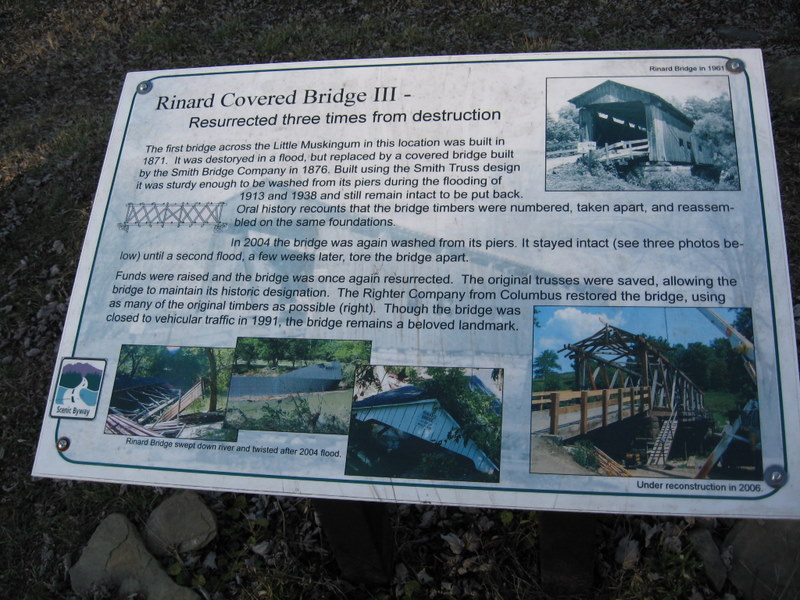
         next up is the rinard mills covered bridge . this bridge has been rebuilt at least a couple of times after being swept off its foundation and just recently has undergone extensive repair . this bridge and the knowlton bridge are no longer used by vehicle traffic and have been bypassed. this is directly south of the knowlton bridge and adjacent to the wayne national forest and st. rt 26. 
       the   plaque gives you historical information and there is ample parking space to pull a vehicle off the road to admire this fine bridge.
        a look on the inside reveals a truss design popular with covered bridge builders of the time. 
Bridgehunter.com | Rinard Covered Bridge- this link will give directions to the covered bridge. these are but a few of the bridges located along st. rt. 26. you can head south from i -76 to st. rt. 800 and after before you get to graysville there is yet another bridge i am yet to find. and south of this bridge and the knowlton is 2 more bridges in the wayne national forest. this is truly a great ride down 26 with a winding road that bends back on its self so much you can almost wipe your tailights clean around the turns. continuing south on st. rt. 26 will bring you into the marietta area. ohio history abounds there with the campus martius museum , and the wp snyder steamboat. more than you can see in one day. i will try to update you with all the bridges names and locations as soon as i figure them all out. dont let the blue skies fool you as they are in ohio. 


Tuesday, February 14, 2012


2-14-2012- dont tell momma i worked in the oil fields , she always thought i was a piano player in a whorehouse. 

        well college was a blur , i learned lots of things there. it costs money to go and if you blow your money and get drunk it makes it hard to make it class the next day and sometimes 2 days later. and somewhere along the way if you don't get a degree , you need to go to work doing something productive. and so since i was living in the wooster ohio ,area and friends were already working in the oilfields making good money it only seemed the natural place to go to work. 
      i had been doing farm work all my life and driving a tractor or operating a piece of equipment was nothing new to me. would have went to work farming and did try that for awhile , but pay was nothing compared to what i could make working in the oilfields at that time. it wasn't long before i was driving truck for halliburton well serv.. at first i started out as labor for a frac crew but soon progressed to an acid truck . the acid truck wasn't to bad . but warnings  of the acid and its use and handling were scarce at best. think i heard , if you get it on you wash it off quick or you will lose skin. and they were right as it wasn't long before i had my first battle scar after splashing some on my hands and it didn't heal for over 2 weeks. was told it was hydroflouric and hydrochloric acid. this was used to clean the well pipe and open the pores of the sand rock we would be fracing the next day. 
     to go out on a frac job in 1977 was an experience and i am sure it is much the same today . first thing after they drill a well to the desired depth and log the oil well, which is where they determine where the oil is by radioactive measurements , they then perforate with dynamite the well casing opening up holes to allow the oil to return to the well casing. then they start the fracing process . 
      trying to simply state what fracing was then as it is now is to hydraulically by water pressure expand the cracks and fissures in oil bearing rock strata to create channels for the oil to return to the drill casing allowing it to be pumped out. they use water acid and now carbon dioxide and nitrogen to freeze the rock at the level of production followed by sand to prop open these channels and create a porous channel for the oil to flow. well maybe not so simple and to imagine that no one knows if it really works for sure at those levels as no one has been to that depth to tell for sure. in theory it works and i wouldn't be surprised watching some wells produce. everything you put down there comes back sooner or later. 
      we would take about 25 trucks back then and convoy from one job to another sometimes doing 2 jobs or 3 if they were close together. 14-16 hr. days were common. we would pull on site and dozers would hook on to the front of your truck and drag you into the well site. sometimes they would rip off your brake lines and mud would be so deep you could reach out the door of the truck and touch mud piled up as high as the truck on both sides of the road. you were not driving as the dozers would pull you up to well head and spin you around as if your truck was a toy, and place you where they wanted you. unlike the semi -paved job sites they offer today. 
    men would pile out of the trucks grabbing heavy iron pipes linking truck to truck until you were all in a way connected to the oil well pipe. water had been brought in by a water truck from a stream close by and placed in large water tanks , valves were opened and water, acid and other chemicals were added by a blender truck and huge pumps would pump this slurry into the well casing  with engines racing so loud you couldn't hear yourself think and steel lines would jump on the ground as the pressure inside the steel casing shot to new heights.sending water acid sand , and slurry a mile down the casing to explode the rock at the bottom of the well . the blender operator was the man who had control of the frac and when a pressure release occurred it was just a matter of shooting the water and sand into the formation as much as they can. then it was tear everything down , load on to trucks , hook to a dozer , and rip off the rest of your brake lines as they pull you out to the road again. a mechanic would wait for us to repair the air lines or to use a tow truck to tow some trucks back who had ripped out rear ends . sometimes you would head home and sometimes you head to another well site. after about 3 months of this madness i was able to switch to a cement crew. this was better but it was a 24 hr. a day job. and it seemed it was always in the middle of the night they would call you.
         you would get so thirsty back then as employees hardly had the benefits they do today, and can remember running out of water and being so thirsty you would drink out of mud puddle and so i did .  as the sweat and heat of the day and the grime was in your system already. so whats a little mud. 
      eventually we would make it back to the shop clean our trucks , and then head to a bar to mark our conquest of nature. to force the earth into yielding those petroleum products we so depend on. still dry from the days heat would lead to over indulgence of the spirits that would take their toll the next morning when we had to roll out for the next round. 6 days a week and sometimes 7 would be nothing to do. you hardly had time to spend money yet still managed to do so. where it went , not quite sure but know it went . i guess the only thing i have left is a memory, and an understanding that life isnt easy, never was, and you have to work at it even when you are having fun. a disabled friend of mine answered after i asked him the other day what he was up to . and he said loud and proud ,' living the dream'. he has to struggle to just work and is out there every day trying his best. couldnt imagine it being a dream being in his shoes but then i guess i never walked that walk.